
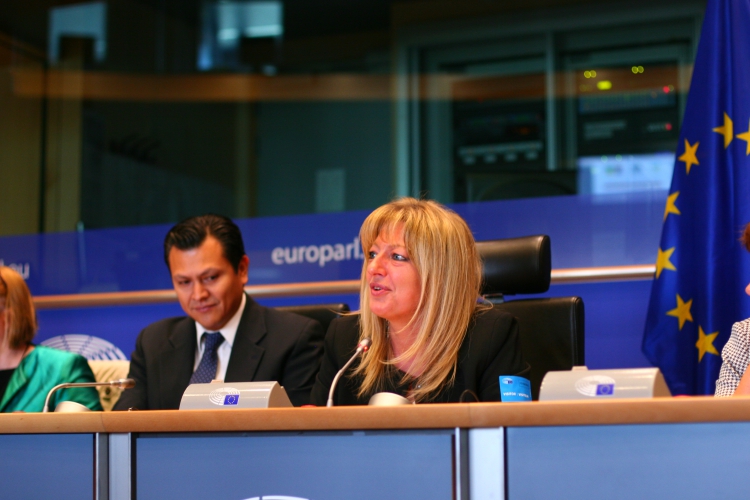
EAEA Secretary-General Gina Ebner interviewed Dr. Katarina Popovic during the European Development Days, held last week in Brussels, Belgium.
Gina Ebner (GE): What do you think about the results of the World Education Forum, organised in Incheon, Korea between 19 and 22 of May?
Katarina Popovic (KP): It was a great and impressive event. Civil society was really present and had a big influence on the whole process and the result. I believe as a civil society, we never had such a success in global policy framework until now. The fact that more than 130 ministers were there who adopted the document and supported its argumentation is also speaking for that.
At the same time it’s depressing from the point of view of adult education. Although the document contains adult literacy and lifelong learning, experiences of the last decade have shown that the fact that lifelong learning is included is still not a guarantee that it will be about adult education.
I believe the moment of truth is coming – and it will be the United Nations’ conference on Financing Development in Addis Ababa, Ethiopia – and I am very skeptical. […] From what we know by now, adult education, including adult literacy, will not have financial support. […] That’s an appeal to European governments and to European civil society to be there, to raise the voice, to make an input, to be very active there when it comes to financing adult education.
GE: I think we will call to our members and the European level to support that. I also have the impression that there is a danger of adult education being marginalized in Europe in the future. You seem to see the same thing at the global level.
KP: If the initiative does not come from European countries – which at least have some functioning system of adult educational learning – where else should the initiative come from? I believe it is a European responsibility to raise the issue, to share the positive experience and to push on the global level.
GE: You are currently here in Brussels for the European Development Days (EDD) and we just had a workshop on Global Citizenship. I would like to hear your estimation and thoughts on the topic within the development framework, but also more generally.
KP: I really think that the EDD are extremely important. They show the awareness of Europe in the global context and global development. But I still think it is not enough. What was mentioned several times during these days is this lack of awareness about importance of global issues in Europe.
In Europe we start to be aware of the global world once it comes to us as a problem – being it terrorist attacks, like Charlie Hebdo and the Copenhagen attacks, or thousands of immigrants who are dying on the shores of Europe. Only at these moments we start to think about getting more involved in the development cooperation. I think this problematic kind of awareness is present on several levels. The focus right now is on policy level, but if you want to do some sustainable efforts then we should take all levels in account: formal education school curricular, but also non-formal education, and adult education. This is a huge task and I would consider this event as a start, but only as a start.
GE: 11–14 June you will be in Montreal, in Canada, for your first ICAE World Assembly as the Secretary-General. What are your expectations of the event? And as a second step, what are your expectations from the European members and the European level when it comes to ICAE?
KP: I believe civil society has to change. The world is changing rapidly and we need to change as well. We are still committed to our basic values, but besides those […] I expect Montreal to give us an input for our future work on how to change advocacy, lobbying and awareness rising. What kind of arguments, what kind of actions could be efficient for this change in a globalized world?
From European members I do expect a lot in Montreal – but also in other forms that they are active in. Compared to other regions, Europe has highly developed adult education learning systems, actions and initiatives. I would really like our European colleagues […] to share that to the world in order to point out the benefits of, not only investment, but the engagement in adult education and learning. Especially to show that adult education is a separate field that can also exist, and that it has a value for itself and is not just an instrument to achieve other things.
From European colleagues who understand the necessity of adult education but set their focus on other fields: I would like them think back and to share their experiences with adult education among their colleagues from around the globe. Children and youth education are surely the basics, but there is another part of lifelong learning spectrum that we have to focus on. Therefore it is important to raise some issues where we made a good experience in education.
GE: Thank you so much and good luck for Montreal. What I also wanted to underline in this discussion is that we as EAEA, but also individually, are very happy to support you in your global work, because it is important. We in Europe have to continue the fight to have adult education recognized as a separate sector to see the value of adult learning. The challenges are probably different on different levels and in the rest of the world, but we need to have that global connection.
Read the full version of the interview or listen it as a podcast at SoundCloud.
Alan Tuckett: “Warm words, weak outcomes: Are we about to fail adults a second time?” (World Education Blog, 28 May 2015)
Text: Gina EbnerPhotos: EAEA